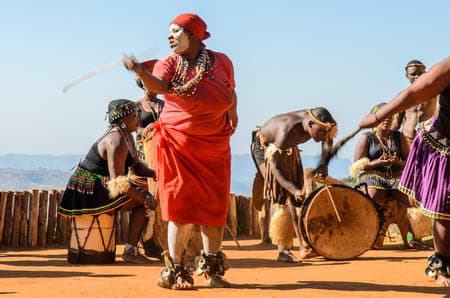
Explore the diverse cultures of South Africa through immersive experiences and authentic interactions.

Image via 123RF
Get in touch with us and we'll get back to you as soon as possible.
Here's what sets us apart from the competition
We deliver exceptional experiences at fair, transparent prices, ensuring every journey offers genuine quality, comfort, and unforgettable adventure without unnecessary costs.
Your journey is crafted around your interests, pace, and travel style, giving you a custom-made adventure that feels authentic, meaningful, and entirely your own.
From planning to your final day of travel, our dedicated team is available to guide, assist, and ensure your trip runs smoothly and stress-free.
Find answers to common questions
Wear modest, comfortable clothing that covers shoulders and knees, bring a hat and water, ask your guide about photography etiquette, and carry small cash for local purchases or community contributions as advised by your guide.
Yes - Zimtrek designs tailor-made cultural activities that consider family-friendly pacing, child-appropriate interactions, and accessibility requirements, coordinating with partners to accommodate mobility limitations where possible.
Zimtrek can include visits to local villages, guided cultural walks, traditional music and dance performances, community-run projects, and markets to provide authentic insights into local life while supporting community partners.
Zimtrek works with vetted community partners and local guides who follow ethical visit protocols, ensure fair compensation, and design interactions that respect local customs and privacy while contributing to community income streams.
English is widely spoken in many tourism areas, and Zimtrek arranges local guides or interpreters when needed to facilitate meaningful exchanges and help navigate cultural nuances.
In This Article
Immerse Yourself in Local Cultures
Culinary and Art Experiences
Historical Context and Modern Insights
South Africa is often described as a single country with many identities, and that is exactly why cultural travel here feels so layered. A well-designed cultural journey can move from township street life to heritage museums, from family-run kitchens to contemporary galleries, and from oral-history encounters to coastal communities shaped by trade, migration, and local tradition. For travellers, the value is not simply in seeing different places. It is in understanding how language, food, music, faith, memory, and daily routines shape the way people live now.
For Zimtrek, the strongest cultural itineraries in South Africa are the ones that are built around context rather than performance. That means selecting experiences where hosts genuinely want to share their world, and where visitors come away with more than photographs. The most rewarding tours often include a local guide who can explain regional history, a meal prepared in a home or community kitchen, and time to ask questions without feeling rushed. This approach matters because South Africa’s cultural landscape is not static. It is alive, changing, and sometimes shaped by difficult histories that still influence the present.
official languages reflect the country’s extraordinary linguistic diversity, alongside many more local dialects and community identities
A meaningful cultural tour is not about checking off sights. It works best when the itinerary leaves room for conversation, interpretation, and local rhythm.
Many travellers arrive expecting South Africa to be defined mainly by wildlife, mountains, and coastline. Those experiences are outstanding, but they become even more memorable when paired with cultural understanding. A day spent learning about neighbourhood history in Johannesburg, for example, changes the way you see the city’s art, music, and food scene. In Cape Town, understanding the layered influences of Malay, African, and European heritage helps explain why the cuisine, architecture, and community stories are so distinct. Cultural travel also creates stronger connections with guides and hosts, because the conversation moves beyond scenery into meaning.
This is also where Zimtrek’s planning style matters. Rather than pushing a standard itinerary, the team can match travellers to experiences that suit their interest level. Some guests want a light introduction through museums, food tastings, and heritage walks. Others prefer in-depth cultural immersion with longer time in communities, local artists’ studios, and historical sites. Family travellers often need a balance: enough activity to keep children engaged, but not so much that the day becomes overwhelming. By shaping the pace and mix of experiences, Zimtrek helps visitors engage with South African culture in a respectful and comfortable way.
Cultural touring in South Africa can take many forms, and the right choice depends on what you want to understand. Some tours are history-led and focus on landmarks, liberation heritage, and interpretive museums. Others are community-led and centered on lived experience, where visitors meet crafters, cooks, musicians, or storytellers. There are also food-focused itineraries, art-and-design routes, and township experiences that reveal how culture is expressed in daily life. The most effective trips often blend two or three of these elements so that the journey feels connected rather than fragmented.
| Tour type | What you experience | Best suited to |
|---|---|---|
| Heritage and history tours | Museums, memorials, liberation history, and guided interpretation | Travellers who want context and deeper historical understanding |
| Community-led experiences | Village visits, local hosts, storytelling, and everyday life | Visitors seeking direct interaction and authentic exchange |
| Food and market tours | Local dishes, market ingredients, cooking demonstrations, tastings | Couples, families, and travellers who enjoy culinary discovery |
| Art and creative routes | Galleries, studios, murals, craft markets, and design spaces | Guests interested in contemporary culture and visual storytelling |
Each style of tour reveals a different layer of the country. Heritage tours are especially strong when they are led by someone who can explain why particular events, neighbourhoods, or institutions matter in the present day. Community-led experiences work best when they are arranged with trusted local partners, because the quality of the interaction depends on trust and preparation. Food tours bring cultural memory to the table in a direct way, and they are often an excellent option for travellers who want a more relaxed pace. Art-focused itineraries are useful in cities where galleries, public murals, and studio visits provide a window into social change and creative identity.
Zimtrek favours cultural experiences that are hosted by people who know the neighbourhood, the story, and the social context - not just the tourist script.
The most compelling cultural destinations in South Africa are not limited to one city or one province. Johannesburg stands out for urban history, creative districts, and important liberation-era landmarks. Cape Town offers a strong mix of culinary heritage, history, design, and community-based experiences. KwaZulu-Natal is valuable for travellers who want to understand Zulu heritage, coastal traditions, and a different pace of life. The Eastern Cape brings another layer, especially for visitors interested in rural identity, resilience, and places connected to major national stories. Each destination tells a different part of the country’s wider story, and the choice should reflect your interests rather than a generic checklist.
If you are planning a broader South Africa journey, it helps to think about cultural destinations as anchors that can be linked to safari or coast experiences. For example, a few days in Cape Town can pair naturally with wine country, while Johannesburg can be combined with heritage travel and onward flights to other parts of the country. Zimtrek uses this kind of route logic to avoid wasted transfer time and to keep the trip balanced. When cultural stops are placed thoughtfully, they add depth without making the itinerary feel overloaded.
| Destination | Cultural strength | Typical travel style |
|---|---|---|
| Johannesburg | History, urban identity, museums, creative neighbourhoods | Best for travellers who enjoy fast-paced city exploration |
| Cape Town | Food, art, architecture, diverse community history | Good for couples, families, and first-time visitors |
| KwaZulu-Natal | Zulu heritage, coastal traditions, local storytelling | Well-suited to travellers seeking regional depth |
| Eastern Cape | Rural heritage, resilience, national history | Ideal for those who want a slower, reflective journey |
What makes these destinations worth exploring is not only what they contain, but how they help travellers understand the country as a whole. South Africa’s cultural identity is spread across urban and rural spaces, across older and younger generations, and across traditions that are preserved, adapted, and reimagined every day. A thoughtful itinerary should reflect that complexity rather than flatten it into a simple tourist narrative.
The most memorable cultural travel in South Africa often happens in the spaces between the famous landmarks. It may be a shared meal where a host explains the history behind a dish, a studio visit where an artist talks about identity through colour and form, or a guided walk through a neighbourhood where public art reveals local memory. These are the experiences that move a trip from observation to participation. They allow travellers to connect with people rather than just places, and they give meaning to the broader journey.
Food is one of the clearest entry points into culture because it is both practical and expressive. South African cuisine tells stories of migration, trade, adaptation, and family tradition. A tasting-focused itinerary can include dishes influenced by Cape Malay heritage, regional braai culture, township comfort food, and modern interpretations by young chefs. That variety is useful for travellers because it creates natural conversation: where ingredients come from, how recipes evolved, and what meals mean in local households. In the right setting, food becomes a lens for history rather than just a pleasant part of the day.
The strongest cultural experiences usually include explanation, participation, and time to reflect - not just a quick stop for photos.
If you are travelling as a couple, a food-and-art combination often works best because it balances intimacy with discovery. Couples typically appreciate a slower pace, a private guide, and time to enjoy a special meal or gallery visit without feeling rushed. Families generally do better with hands-on experiences such as craft workshops, short heritage walks, and interactive community visits where children can ask questions and stay engaged. Travellers with a strong interest in history should prioritise museums, interpretive sites, and guided conversations that go beyond dates and names to explain how the past still shapes current life.
For small groups, the advantage is flexibility. Zimtrek can build a route that mixes one city day with one township or community day, then adds creative or culinary elements to keep the trip varied. That structure works well because cultural travel can become tiring if every day asks the traveller to process heavy information. Alternating between emotional, reflective, and lighter experiences gives the itinerary more rhythm. It also helps with logistics, since some community-led activities are better done with advance coordination and a smaller, well-briefed group.
Cultural travel works best when visitors arrive prepared to listen as much as they look. Respect for local customs is not complicated, but it does require attentiveness. Dress should suit the setting, especially when visiting communities or religiously significant places. Photography should never be assumed; ask before taking portraits or detailed images of homes, people, or ceremonies. If a host introduces a topic that touches on inequality, politics, or historical pain, it is better to listen carefully than to steer the conversation away too quickly. Good guides help translate those moments into understanding, but travellers also have a role in creating a respectful exchange.
Logistics matter just as much as etiquette. Some cultural experiences are best scheduled in the morning, when people are fresher and travel flow is smoother. Others work better in the late afternoon, especially food and creative activities that naturally lead into dinner. In larger cities, traffic can affect timing more than people expect, so a realistic itinerary will build in margin between stops. Zimtrek’s planning approach is useful here because it combines route knowledge with partner relationships. That means guests are not left guessing whether a township tour, museum visit, or home-hosted meal fits comfortably into the day.
| Practical point | Why it matters | Useful traveller approach |
|---|---|---|
| Guided interpretation | Adds historical and social context to what you see | Choose local guides with community knowledge |
| Timing and pacing | Prevents rushed transfers and tired travellers | Allow buffer time between activities |
| Photography etiquette | Protects dignity and builds trust | Ask first, especially in homes and community spaces |
| Meal planning | Cultural tours often include food and shared dining | Share dietary needs before travel |
Do not assume every community visit is a public attraction. Some experiences are carefully hosted and need advance coordination, punctuality, and clear expectations.
A well-planned cultural trip in South Africa starts with a clear idea of your travel style. If you prefer a structured experience, Zimtrek can design a route with private transfers, trusted guides, and a balanced mix of historical and contemporary stops. If you want a slower, more personal journey, the itinerary can include longer meals, artisan visits, and fewer location changes. For travellers combining culture with leisure, it is possible to build a South Africa route that includes city heritage, culinary experiences, and time for relaxation without making the trip feel crowded.
Budget should be considered in terms of value rather than just headline price. Cultural experiences vary depending on the level of exclusivity, the length of the tour, the number of included meals, and the expertise of the guide. Private interpretation, curated tastings, and community-led encounters usually cost more than standard sightseeing, but they also deliver a richer result. In practical terms, many travellers find that investing in one or two well-chosen cultural days creates a better trip than trying to add too many superficial stops. Zimtrek’s role is to help you decide where that value is highest for your interests.
A useful planning method is to organise your cultural journey around a central theme: heritage, food, art, family connection, or contemporary identity. That theme keeps the itinerary coherent and helps the guide choose the right stops. It also makes it easier to connect your South Africa travel with surrounding experiences in a logical way. If you are arriving from a safari region or continuing to a beach stay, a cultural segment can act as a bridge between active travel and rest. If your trip is entirely city-based, the cultural itinerary can become the main story of the holiday.
Zimtrek’s advantage is not only arranging transport and bookings; it is matching you with the right pace, guide style, and local experiences for a trip that feels intentional.
Get in touch with us and we'll get back to you as soon as possible.
Here's what sets us apart
We deliver exceptional experiences at fair, transparent prices, ensuring every journey offers genuine quality, comfort, and unforgettable adventure without unnecessary costs.
Your journey is crafted around your interests, pace, and travel style, giving you a custom-made adventure that feels authentic, meaningful, and entirely your own.
From planning to your final day of travel, our dedicated team is available to guide, assist, and ensure your trip runs smoothly and stress-free.
Don't just take our word for it
Keep reading